
The Myth of the “7-Star Hotel”: When Luxury Language Becomes Investment Psychology

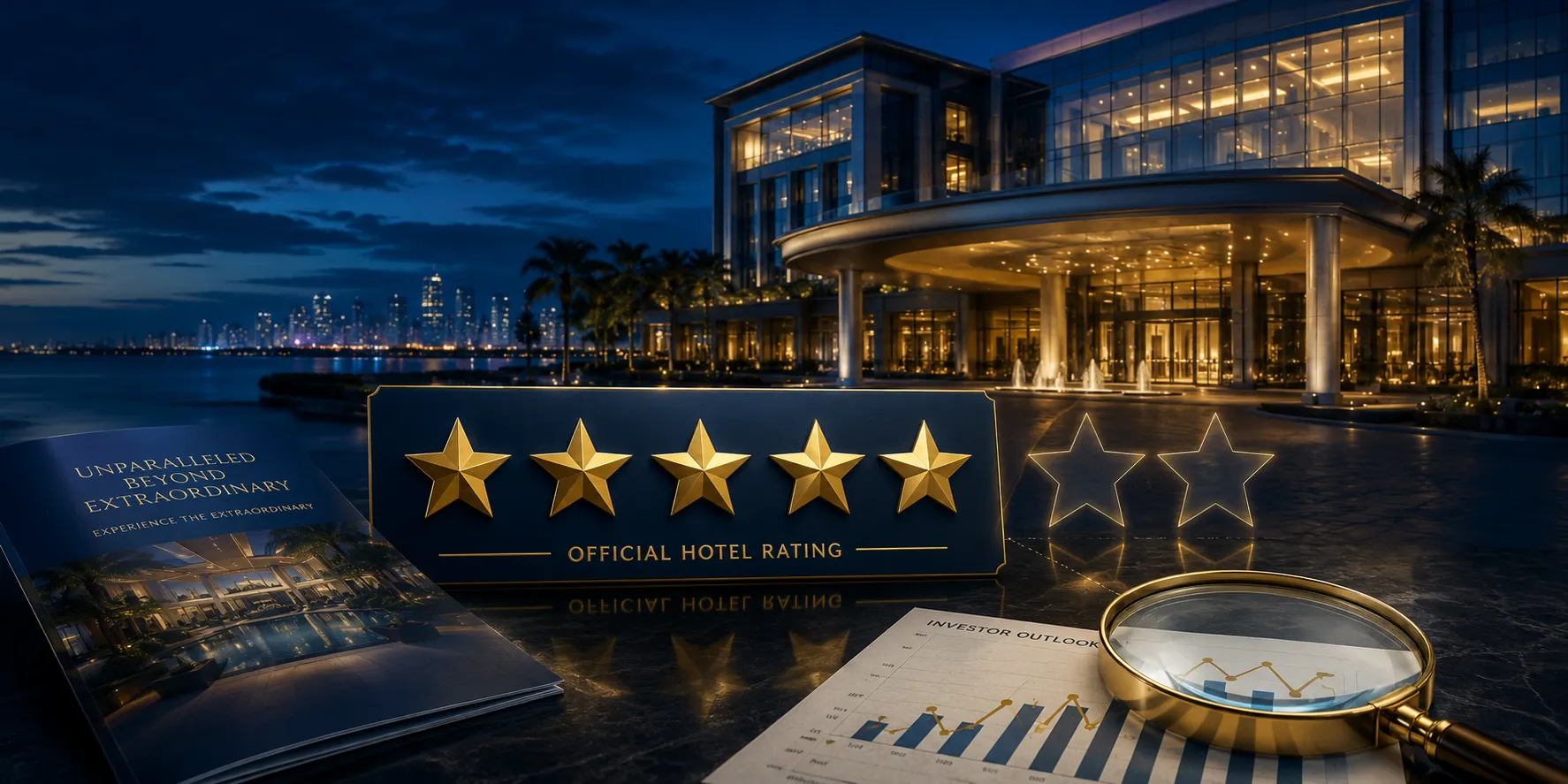
In the hotel industry, the phrase “7-star hotel” sounds powerful. It creates an instant image of extreme luxury, global prestige, royal service, high-net-worth guests, and exceptional returns. For a retail investor looking at a hotel, resort, branded residence, serviced apartment, or mixed-use hospitality project, the phrase can feel like a shortcut to confidence.
But scientifically, commercially, and institutionally, the problem is simple: there is no official global hotel rating system that goes up to seven stars.
The internationally understood hotel star classification framework generally stops at five stars. While rating systems vary by country, tourism authority, and private inspection body, the highest formal hotel category in recognised star-based systems is normally five stars. A hotel may be ultra-luxury, iconic, expensive, architecturally extraordinary, and operationally excellent. But that does not make it officially “7-star.”
The term “7-star” is not a regulated classification. It is a marketing expression.
That distinction matters, especially when such language is used not merely to attract hotel guests, but to attract investors.
Five Stars Is a Classification. Seven Stars Is a Story.
Hotel classifications exist to provide a structured indication of accommodation standards. They typically assess tangible and operational criteria such as room size, bathroom facilities, reception hours, food and beverage services, housekeeping standards, safety, accessibility, amenities, maintenance, guest services, and in some systems, sustainability and digital readiness.
These systems are not perfect. They differ between countries. A five-star hotel in one jurisdiction may not be identical to a five-star hotel in another. Some countries have official government-led systems. Some use hotel associations. Some rely more heavily on private rating guides or online guest reviews. But despite these differences, the star concept remains broadly understood as a one-to-five scale.
Five stars generally represents the highest official category in a star-based hotel classification framework. Above that, certain systems may use words such as “luxury,” “deluxe,” “superior,” “platinum,” or other supplementary descriptors. But those are not the same as a globally recognised six-star or seven-star classification.
This is where marketing begins to blur the line.
A developer, promoter, or sales agent may describe a project as “7-star” to suggest that it is beyond luxury. The phrase creates emotional impact. It implies scarcity. It tells the listener: this is not an ordinary hotel investment; this is something elite, rare, and globally prestigious.
But from a technical hospitality perspective, “7-star” does not answer the essential questions:
- Who awarded the rating?
- Under which classification system?
- What criteria were assessed?
- Was there an inspection?
- Is the rating recognised by a government tourism authority, a credible inspection body, or merely by the promoter?
- Is the property even operational yet?
Without answers to these questions, “7-star” is not evidence. It is language.
The Burj Al Arab Example: How a Phrase Became a Myth
The most famous example is the Burj Al Arab in Dubai. It is one of the most iconic luxury hotels in the world. Its sail-shaped architecture, all-suite configuration, butler service, dramatic interiors, and global publicity made it a symbol of modern luxury hospitality.
Because of its extraordinary positioning, the Burj Al Arab became widely associated with the phrase “7-star hotel.” However, the phrase was never a formal global hotel classification. It is commonly understood to have originated from a journalist’s description during the hotel’s launch period, essentially saying that the hotel felt like “seven stars out of five.”
That is a compliment. It is effective publicity. It is memorable branding.
But it is not an official rating system.
This distinction is important. If one of the most famous hotels linked to the “7-star” label did not receive that label from a recognised seven-star global classification authority, then investors should be cautious when lesser-known projects use the same language as though it represents a formal credential.
The Burj Al Arab became iconic because of real architecture, real operations, real service culture, real destination positioning, and real brand power. The “7-star” phrase followed the product. In weaker investment promotions, the opposite often happens: the phrase appears before the evidence.
Why “7-Star” Works Psychologically
The phrase works because it uses a simple psychological trick: it borrows credibility from a familiar scale and then exaggerates it.
Most people understand five stars as the top rating. So when someone says “7-star,” the mind immediately interprets it as “better than the best.” It creates an artificial premium without requiring the promoter to prove anything in detail.
This is especially effective in retail investment marketing because many retail investors are not hotel operators. They may not know the difference between:
- a hotel classification and a brand standard,
- a franchise agreement and a management agreement,
- a projected return and a guaranteed return,
- a luxury concept and a bankable hotel feasibility study,
- a serviced apartment and a hotel apartment,
- or a brand name and actual operational control by that brand.
The phrase “7-star” simplifies all of that complexity into one emotional message: premium.
That is why it is commercially powerful. It appeals to aspiration, not analysis.
Luxury Does Not Automatically Mean Profitability
Even a genuine five-star hotel is not automatically a good investment. Luxury hospitality is capital intensive. High-end hotels require expensive construction, premium finishes, higher payroll, stronger maintenance, larger public areas, sophisticated technology, brand standards, pre-opening costs, sales and marketing investment, working capital, and continuous asset upkeep.
A luxury hotel may achieve a high average daily rate, but it may also carry high operating costs. A beautiful property can still suffer from weak occupancy, poor market access, seasonality, oversupply, weak management, unrealistic debt, poor distribution strategy, or an unsuitable location.
For investors, the key issue is not how many stars appear in the brochure. The key issue is whether the business model works.
A hotel investment should be assessed using proper commercial indicators such as:
- market demand,
- competitive supply,
- projected occupancy,
- average daily rate,
- RevPAR,
- gross operating profit,
- net operating income,
- construction cost per key,
- pre-opening budget,
- working capital requirement,
- brand fees,
- management fees,
- replacement reserve,
- debt servicing capacity,
- and realistic exit value.
A “7-star” claim does not answer any of these questions.
In fact, it can distract from them.
When “7-Star” Is Used to Attract Retail Investors
The concern becomes stronger when “7-star” language is used in investment promotions rather than ordinary hotel marketing.
A guest booking a room may understand “7-star” as harmless exaggeration. They can compare reviews, photos, location, price, and brand reputation before booking. Their exposure is limited to the cost of a stay.
A retail investor, however, may be committing savings, retirement funds, borrowed money, or family capital. The risk is much higher. If the investment is promoted using artificial prestige instead of audited financials, verified permits, independent feasibility studies, and transparent ownership structures, the investor may be influenced by emotion rather than evidence.
In such cases, “7-star” language can become a warning sign.
It does not automatically mean the project is fraudulent. A legitimate developer may use exaggerated language carelessly. But it should trigger deeper due diligence. The more extravagant the claim, the stronger the evidence should be.
If a promoter claims a project is “7-star,” investors should ask:
- Who officially awarded this rating?
- Can I see the classification certificate?
- Is the property already open and inspected?
- If not open, how can the rating already exist?
- Which tourism authority recognises seven stars?
- Is there a signed hotel management agreement with a recognised operator?
- Is it a franchise, a management contract, a white-label arrangement, or only a proposed brand discussion?
- Is the projected return based on independent hotel feasibility or internal sales assumptions?
- Are the promised returns guaranteed, forecasted, or merely illustrated?
- Who holds investor funds?
- What happens if the hotel opening is delayed?
- What happens if occupancy or room rates fall short?
These are not hostile questions. They are basic investment questions.
The Difference Between Branding and Classification
Another common confusion is the difference between a hotel brand and a hotel rating.
A hotel may carry an international brand, but that does not automatically mean the brand owns the property or manages it directly. Many hotels operate under franchise agreements. In a franchise model, the owner may use the brand name and systems, but day-to-day operations may be handled by the owner or a third-party operator. In a management agreement, the brand or operator may be more directly involved in running the hotel. In some cases, the brand may only be proposed, not finalised.
Similarly, a hotel may be described as “luxury,” “upper upscale,” “premium,” or “lifestyle,” but these are market positioning terms. They are not the same as official star classification.
This distinction matters because investment promoters sometimes combine several impressive-sounding concepts into one message:
- international standard,
- luxury branded,
- 7-star quality,
- guaranteed returns,
- limited units,
- capital appreciation,
- world-class destination.
Each phrase may sound reassuring. But each phrase must be separately verified.
What Serious Hospitality Investors Look For
Professional hotel investors do not invest because a brochure says “7-star.” They look for evidence.
They want to see the land title, planning approvals, construction budget, operator agreement, brand agreement, market study, competitive set, projected profit and loss, debt structure, tax assumptions, insurance, licensing pathway, pre-opening plan, and exit strategy.
They also assess whether the proposed positioning fits the destination. An ultra-luxury hotel requires more than marble, chandeliers, infinity pools, and impressive renderings. It requires air access, destination demand, strong management, trained staff, service culture, supplier networks, security, reputation, and enough guests willing to pay premium rates throughout the year.
Luxury cannot be created only by adjectives.
A five-star operation is difficult enough to execute. A claimed “7-star” operation should invite even greater scrutiny, not less.
A Practical Investor Rule
A simple rule can protect investors:
The more extraordinary the claim, the more ordinary the evidence should be.
By “ordinary evidence,” we mean documents that serious investors normally review: licences, approvals, contracts, audited numbers, feasibility reports, construction progress, escrow arrangements, legal structure, and independent professional opinions.
If the evidence is weak but the language is grand, be cautious.
If the promoter focuses heavily on lifestyle images, celebrity-style language, artificial scarcity, emotional urgency, and exaggerated classifications, but avoids detailed financial and legal disclosure, the investor should slow down.
A hotel investment is not validated by the number of stars in a sales pitch. It is validated by the quality of the asset, the strength of the market, the credibility of the operator, the realism of the financial model, and the legal protection given to investors.
Conclusion: Prestige Is Not Proof
The phrase “7-star hotel” is powerful, but power is not the same as accuracy.
There is no official global hotel rating system that awards seven stars. The recognised star-based hotel classification concept generally reaches its highest point at five stars, although different countries and private bodies may use additional descriptors or separate award systems.
Therefore, when “7-star” language is used, especially in retail investment promotion, it should be treated as marketing – not as proof of quality, not as proof of profitability, and not as proof of safety.
A hotel can be exceptional without being “7-star.” A project can be luxurious without being a sound investment. And a brochure can sound prestigious while still leaving the most important questions unanswered.
For investors, the right response is not to be impressed by the phrase. The right response is to ask for evidence.
Because in hospitality investment, real value is not created by invented stars.
It is created by land, permits, design, construction discipline, operator strength, service delivery, market demand, cash flow, and transparent governance.
Everything else is decoration.





Responses