
Moving from Chief Accountant to Financial Controller in Hotels & Resorts: A Practical Roadmap

Many hospitality finance professionals reach a point where they ask:
“I’m a good Chief Accountant… but what exactly do I need to become a Financial Controller?”
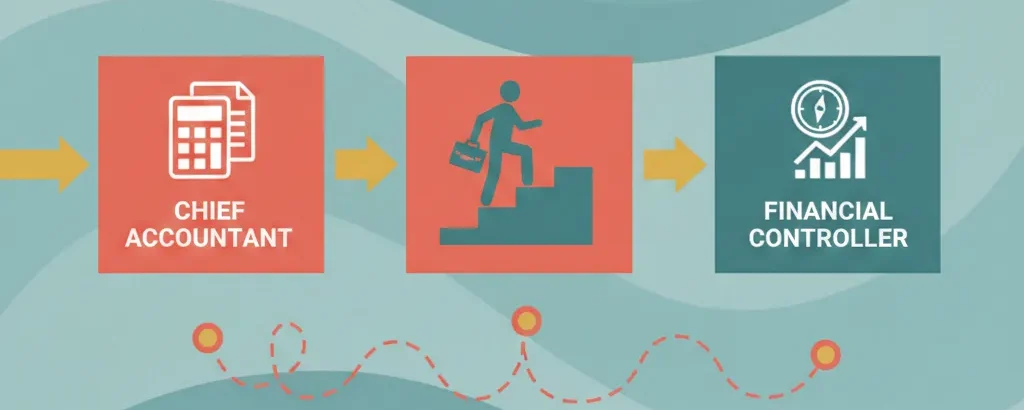
In hotels and resorts, this transition is more than just a title change. It involves shifting from “being the expert” to “being the leader and business partner”.
This article offers a practical roadmap for moving from Chief Accountant (or equivalent) to Financial Controller in a hospitality environment.
1. Understand the Core Mindset Shift
As Chief Accountant, your focus is often:
- Accuracy of accounts
- Month-end closing
- Reconciliations and compliance
- Managing a small team within finance
As Financial Controller, your role expands to:
- Being the right hand of the General Manager on financial matters
- Presenting performance to owners, asset managers, and brand
- Guiding department heads on how to achieve financial targets
- Looking ahead (budgeting, forecasting, risk) instead of only looking back
A simple way to think about it:
- Chief Accountant = “Are the numbers correct?”
- Financial Controller = “What do the numbers mean and what should we do?”
Start training your mind to always ask: “So what? What action does this number suggest?”
2. Strengthen Your Business Understanding Beyond Finance
Controllers are expected to understand how the hotel actually works, not just the accounts.
Key areas to get comfortable with:
- Rooms operations – pricing, distribution channels, OTA commissions, upselling, group vs FIT, seasonality.
- F&B – menu engineering, banquet pricing, cost drivers, promotions, outlet mix.
- Spa & Recreation – capacity, utilisation, membership models, package structures.
- Sales & Marketing – segments, contracts, rate loading, cost of acquisition.
- Engineering – preventive maintenance vs. reactive repairs, energy consumption patterns, CAPEX planning.
Practical steps:
- Join morning briefings and revenue meetings regularly.
- Spend time in Front Office, F&B, and other departments to see processes live.
- Ask HODs to explain their operation – not to audit them, but to understand them.
The better you understand the business model, the more credible you become as a future Controller.
3. Master USALI and Internal Management Reporting
Most hotels and resorts (especially branded properties) use the Uniform System of Accounts for the Lodging Industry (USALI) or a similar framework.
As a Chief Accountant, you may already post and prepare reports under USALI. To move towards Controller:
- Make sure you understand why each account sits where it does.
- Know the difference between operating departments, undistributed expenses, and fixed charges.
- Be comfortable explaining key ratios: department profit %, GOP %, flow-through, payroll %, etc.
- Practice preparing simple commentaries for each schedule: what changed vs budget/last year and why.
You don’t have to be perfect at the start, but you should show that you can interpret the USALI schedules, not just produce them.
4. Build Budgeting & Forecasting Skills
Controllers are heavily involved in budget season and reforecasts.
If your current exposure is limited:
- Volunteer to support the Controller in preparing the next budget/forecast.
- Take responsibility for a few departments (e.g., Admin & General, HR, Engineering) and build their budgets under guidance.
- Learn how rooms and F&B budgets are built:
- Rooms: occupancy, ADR, segment mix.
- F&B: covers, average check, banquet revenue, cost of goods, payroll.
Your goal is to demonstrate you can move from:
“I can close the month and compare actual vs. budget”
to
“I can help build a realistic budget and explain variances.”
5. Develop Your Communication & Presentation Skills
A strong Controller is also a strong communicator.
You’ll need to:
- Present monthly performance to GM and owners.
- Explain variances in simple language that non-finance colleagues can understand.
- Sometimes deliver tough messages about cost control or missed targets.
Practical ways to develop this:
- Offer to present a small part of month-end results in internal meetings (e.g., focus on 1–2 departments).
- Practice turning complex tables into 3–4 key messages.
- Use simple visuals (charts, key ratio summaries) when you share information.
Ask your Controller or GM for feedback after each presentation, and adjust accordingly.
6. Start Acting as a Partner to HODs
Controllers are seen as partners – not just auditors.
Begin building that reputation:
- When you spot a variance, don’t just send a warning email. Sit with the HOD and explore why it happened and what can be done.
- Offer to help them track key KPIs specific to their department (e.g., cost per cover, payroll efficiency, upsell impact).
- Celebrate wins with them when results improve – don’t only appear when there is a problem.
If department heads already see you as someone who helps them succeed, they will naturally accept you as Controller when the time comes.
7. Gain Exposure to Owners & Corporate
In many properties, the Controller is the main finance contact for owners and corporate offices.
If you’re aiming for that role:
- Ask your Controller if you can sit in on owner call meetings (even if just as an observer).
- Volunteer to prepare the owner pack and presentations, not just the raw data.
- Learn what owners care most about: cash flow, GOP, CAPEX, returns on investment, forecast reliability.
This exposure helps you understand the political and strategic side of the role, not just the technical.
8. Learn the Basics of Cash Flow & Financing
Beyond P&L, Controllers must keep an eye on cash:
- Supplier payments and credit terms
- Bank facilities and covenants
- Large CAPEX payments
- Seasonal cash fluctuations in resorts
Start discussing:
- The cash flow forecast and how it’s built
- How payment priorities are set in tight months
- How financing arrangements with banks are managed (if applicable)
You don’t have to become a treasury expert, but you should understand the basics and show you’re thinking about cash, not just profit.
9. Prepare Yourself as a Leader, Not Just a Senior Accountant
As Controller, you will be leading a team: Chief Accountant, AP, AR, Cost Control, Income Audit, Cashiers, etc.
That means:
- Coaching and mentoring team members
- Delegating effectively instead of doing everything yourself
- Handling conflicts and performance issues
- Representing your team in front of GM and owners
You can start now by:
- Training junior staff in specific tasks.
- Delegating some work and then reviewing rather than re-doing.
- Giving structured feedback (what they did well, what to improve).
If your team and your current Controller see you as someone who can develop people, you become a natural successor.
10. Talk Openly About Your Career Goal
Finally, don’t keep your ambition a secret.
Have a professional conversation with your Controller and/or GM:
- Express that you aim to become a Financial Controller in the near future.
- Ask what skills or experiences they believe you still need to develop.
- Request opportunities to take on more responsibility in those areas.
Be open to feedback and ready to work on it. Many Controllers are happy to support and groom their successor – it also reflects well on them.
Final Thoughts
Moving from Chief Accountant to Financial Controller in hospitality is an achievable step if you:
- Shift your mindset from accuracy to business leadership
- Build commercial understanding of hotel operations
- Develop communication, budgeting, and people leadership skills
- Proactively seek exposure to owners, corporate, and cash flow decisions
It doesn’t happen overnight, but each month you can deliberately position yourself a little closer to the role. When the opportunity comes – internally or in another hotel – you’ll be ready not just to hold the title, but to perform the role.

Responses